[This blog post is part of Trek Light’s Sleeping In A Hammock series. If you came here first, do yourself a favor and check out what you’ve missed by starting at the beginning.]
If you’ve gotten this far, it means you now know how to choose the right hammock.
You’ve hopefully already got yourself a Trek Light Hammock or at least one which meets the criteria for a comfortable and healthy hammock experience.
Which means that we’ve now arrived at the next most important question I get asked on a regular basis:
“How do I lie in this thing?”
Before I share with you everything I’ve learned about the best way to setup and lie in your hammock, I’ll be quick to point that there really can never be a right way and a wrong way to enjoy your hammock.
If the hammock you use and how you use it works for you and you’re as comfortable as you’ve ever been and sleeping perfectly then keep on doing it.
But, what you’ll read in this post (and the entire series) is advice based on my years of experience sleeping in a hammock, learning about the history of the hammock and talking to literally thousands of people from around the world about their hammock experiences.
I’m about to share with you a small bit of technique and knowledge that, if new to you, can change your entire hammock experience forever.
Let’s Beat The (Hammock) Curve
Everything is set and ready to go: you’ve got your hammock setup, a comfortable pillow, maybe a nice margarita or a cold beer and you’re planning on taking a nap or getting a full night’s sleep in your hammock.
You take one look at the hammock and suddenly you’re staring at something that doesn’t make any sense at all - it’s curved!
How can you possibly sleep comfortably in something shaped like a banana?
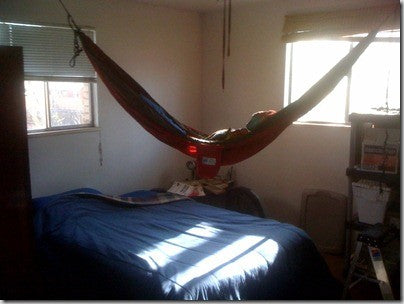
As we learned in Part I, this reaction to the traditional hammock design is exactly why the spreader bar came into existence.
When the hammock was introduced to European culture, the curve of the hammock was considered unacceptable and they did what was necessary to make the hammock appear as flat as possible (at the sacrifice of both stability and portability). But, the hammock had existed, not as a recreational backyard gadget but as a fully functional bed, for hundreds of years before the spreader bar was added.
Sleeping in a giant curve can’t be good, so did all of these early hammock users sleep horribly every night? Did they wake up every morning shaped like a boomerang but continue to use the hammock because they just couldn’t think of any way to fix the problem - like, say with a simple spreader bar?
(Go ahead and say it with me, “Noooooo!”)
Step 1: How to Avoid The Most Common Hammock Setup Mistake
When it comes to setting up a hammock, especially one that’s as quick and easy to setup as Trek Light’s, there’s honestly very little that you need to know in order to do it properly.
There's really only one aspect to the setup where you’re forced to make an extremely important and not-so-obvious choice: how tight or how loose should you hang the hammock?
As we’ve learned from our hammock history, the first instinct most people have is to do anything they can to eliminate the big curve of the hammock. You know you want a flat (or fairly flat) surface to sleep on and just looking at the strong curve of the hammock is already giving you back pain.
So, you decide to just pull it as tight as possible to get the surface nice and flat. You’ve just made a mistake.
Believe it or not, the natural curve of the hammock is crucial to getting the flat, zero-pressure point surface that makes hammocks such a healthy way to relax, meditate or sleep.
One of the biggest mistakes you can make is to try to pull your hammock as tight as possible in an attempt to make it flat.
When you pull the hammock tight it’s certainly going to appear flatter and more like something you want to sleep on. But, no matter how tight you pull it, the hammock will still dip down in the center when you get in it.
Here’s what else will happen if you pull the hammock tight:
You’ll find yourself tightly ‘cocooned’ by the sides of the hammock. When you’re lying down you’ll likely have high hammock walls around you (unless you use your arms to hold them down like you’ll see in some of the pictures below). The tight frame of the hammock can even make some feel claustrophobic, a feeling you should never have to worry about in a hammock.
The tight side ‘walls’ of the hammock will force you to stay pretty much right in the center of the hammock with little room or ability to stretch out or change positions (you’ll learn why this is such a problem coming up).
A hammock pulled as tightly as possible also greatly increases the amount of pressure and force being put on the objects you’re hanging it from. This can lead to a greater chance of causing damage or breaking the object you're hanging from, whether it’s a tree or your front porch.
Let’s take the leap forward from what to avoid to what to do…
Step 2: Loosen Up And Hang Loose
Seth’s Hammock Wisdom: If the material of your hammock feels loose and relaxed, you soon will too.
Keeping the material loose gives you a lot more space to stretch out and take advantage of the full width of the hammock.
Without even applying the Hammock Angle trick you’re about to learn, I think you’ll immediately find that any time you spend in the hammock is much more comfortable, liberating and relaxing - all thanks to the looseness of the material itself.
Step 3: The Hammock Angle Changes Everything
To sum up what I’ve told you so far:
1.) Sleeping in a curve sucks. Don’t do it.
2.) Hang your hammock loose. Don’t fear the curve.
Am I just messing with you here?
If sleeping in a C-shape is bad for your body and I’m telling you to hang your hammock with a nice, loose curve to it, how the heck are you supposed to lie flat and get a good night’s sleep?
The answer is the Hammock Angle. (The "Hangle", if you will).
And it changes everything.
The reason I’ve spent so much of this post telling you what happens when you pull your hammock really tight and why you should hang it loose is because you’re going to need to use the full width of the hammock to your advantage to execute the Hammock Angle.
The Hammock Angle is best understood for the first time like this:
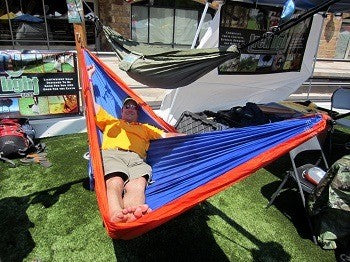
Begin by lying in the hammock directly down the center as you normally would. Now, take your feet and legs and move them about 8-12 inches to one side. Now, do the exact same thing with your head and the upper part of your body, except towards the opposite side.
If you did it correctly, you’re now lying almost completely flat in a curved hammock.
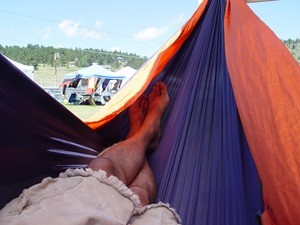
It’s of course one of those things that is much easier to experience than to explain, but by just shifting your body a small amount you’re actually cutting across the curve of the hammock. The hammock responds by flattening out underneath you, gently cradling your body in what just so turns out to be an absolutely ideal sleeping position with zero pressure points.
If you like numbers: you’re aiming for roughly 30 degrees off the hammock’s centerline. If you don’t like numbers: feet one way, head the other, until it feels flat. Your body will tell you when you’ve found it.
One more trick the hammock veterans swear by: hang the foot end of your hammock about 8-10 inches higher than the head end. It looks lopsided and feels like a mistake until you lie down, and then you’ll notice you’ve stopped sliding toward the middle of the hammock during the night. Little things.
You’re not going to be perfectly flat, but your body doesn’t need to be perfectly flat, and your head and feet will be slightly elevated as they should while the material conforms to the natural curve of your spine.

Think You Can’t Sleep On Your Side In A Hammock? Think Again!
Using the Hammock Angle to create a nearly flat hammock surface opens up a wide range of sleeping positions that just aren’t possible in a hammock otherwise (not comfortably anyways).
And don’t forget, Trek Light’s hammocks are designed to never spin or flip you out so you’ve got nothing to fear when moving around or shifting positions in the hammock. In 20+ years I have yet to hear from a single customer who has ever managed to roll up and out of the hammock while sleeping. (New to hanging? Two minutes with our Hammock Safety guide before your first hang is time well spent.)
Every double hammock we make is rated to 440 lbs and backed by our Lifetime Warranty and Happiness Guarantee, so you can stretch out and move around up there without doing math about it.
Here’s something else I find really interesting: I'm a side sleeper and it’s almost impossible for me to sleep on my back when I’m sleeping in a normal bed - but I can do it every night in a hammock.
Lying on your back supposed to be a healthier way to sleep and I’ve tried but I just can’t sleep on my back in a bed. If I somehow manage to fall asleep on my back I’ll always wake up a few minutes later and shift over to my side.
But, strangely enough, when I’m sleeping in a hammock I often wake up and realize that I’ve been comfortably sleeping on my back for hours. If I initially fall asleep on my back, I also tend to stay that way throughout the night and feel amazing when I wake up!
What makes that major change in my sleeping habits possible?
The answer lies in the fact that the reason we shift around at night and prefer one sleeping position to another is primarily rooted in pressure points. Remove those pressure points and sleep on a surface that conforms to your body’s natural curves - and you’ll be amazed at the difference.
I’ll leave you again with a quote from the sleep study I referenced in the Sleeping In A Hammock Is Good For You post:
So what is considered the all-round healthiest sleep position? Many doctors say it’s lying on one’s back, with the head slightly elevated, about 10 – 30 percent. This is postulated to give the brain optimal blood circulation rather than congestion and also allows for more un-obstructed breathing, says Dr. Steven Park, a head and neck surgeon and member of the American Academy of Sleep Medicine.You see many native cultures sleeping this way, via hammock and other devices, rather than on flat surfaces as in the West.
One Warning Before You Sleep Out There
Inside on a summer afternoon, skip this section. But if you’re sleeping outside, know this: in a hammock, the cold comes from BELOW. Your body compresses whatever you’re wearing, and the breeze that feels so good at 2pm becomes a problem at 2am. The fix is insulation underneath you: a sleeping pad inside the hammock or an underquilt below it, any night that dips below sweatshirt weather. We cover the whole cold-weather setup in our Hammock Camping in Cold Weather guide.
Hammocks & Whiskey: Make Mine A Double
Since we just learned that the width of the hammock is what gives you the room to achieve a good Hammock Angle and sleep flat, a Double Hammock is what I recommend if you plan on sleeping in your hammock. It’s what I prefer to sleep in and fits me with plenty of room to spare (I’m 6' tall).
If you want the short version of shopping for one, the Double Hammock with Pro Hanging Straps is the setup I hand to friends. Rated to 440 lbs, carabiners already attached, straps included.
Apply the same "Make it a Double!" rule of thumb the next time you order or pour yourself a whiskey and life will be grand!
Hammock Angle FAQ
Can you sleep on your side in a hammock?
Yes. Use the Hammock Angle to flatten the hammock first: feet 8-12 inches to one side, upper body to the other. Once the surface is nearly flat, side sleeping works the way it does in a bed, minus the pressure points.
What angle should you lie in a hammock?
Roughly 30 degrees off the centerline. Shift your feet 8-12 inches one way and your head the other, and the curved hammock flattens out underneath you.
How tight should a hammock be hung?
Looser than your instincts say. Pulling a hammock tight makes it LESS comfortable: the sides wall up around you and you lose the width you need to lie at an angle. A nice deep curve in the empty hammock is what you want.
How do I stop sliding to the middle of the hammock?
Hang the foot end about 8-10 inches higher than the head end. Counterintuitive, works every time.
Do I need anything else to sleep in a hammock overnight?
Outside, yes: insulation underneath you (a pad or underquilt) on cool nights, and tree-friendly straps to hang from. Inside, just a pillow and a good excuse.
The Gear That Makes It Work
Everything in this guide assumes a hammock wide enough to lie across, which is why I always point people at the Double Hammock. Our current bundles come with Pro Hanging Straps included, or browse all hammocks. Taking it somewhere? Our guide to portable hammocks that actually pack down small covers packed size, weight, and what to do when there are no trees.
Every one that goes out plants a tree through Trees For The Future, which feels like fair rent on the two you hang between. The whole story is on our give-back page.
And we’re done! I really wanted to do this topic justice by giving you a true guide to hammock comfort and not just a quick outline, so thanks for reading along and allowing me to share what I’ve learned with you.
I hope you’ve enjoyed the entire Sleeping In A Hammock series and I sincerely appreciate all the great comments, emails and phone calls we’ve received in response to it already.
And if you are still shopping rather than hanging, we compared the best camping hammocks on the numbers that actually differ.
Even though I’m wrapping it up I’m sure there will be plenty of more posts down the road which will extend this theme even further. I love helping people get the most out of their hammock experience so please let me know what questions you still have about getting comfortable in a hammock, or what other hammock or non-hammock topics you’d like to see explored on the Trek Life blog!